
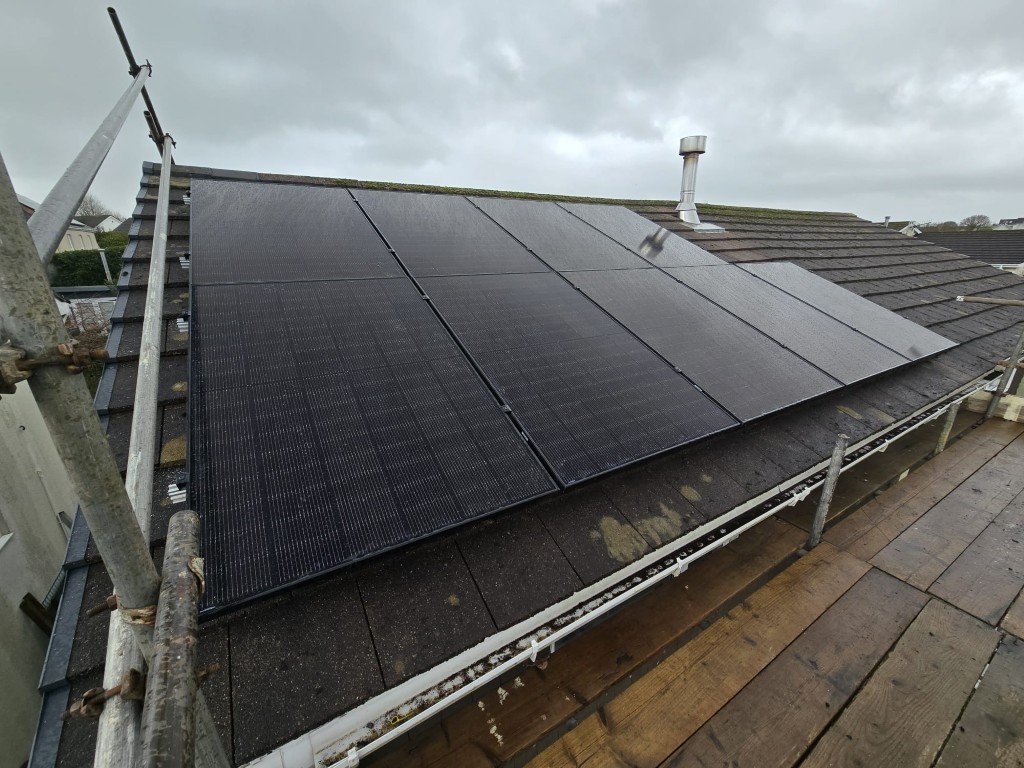
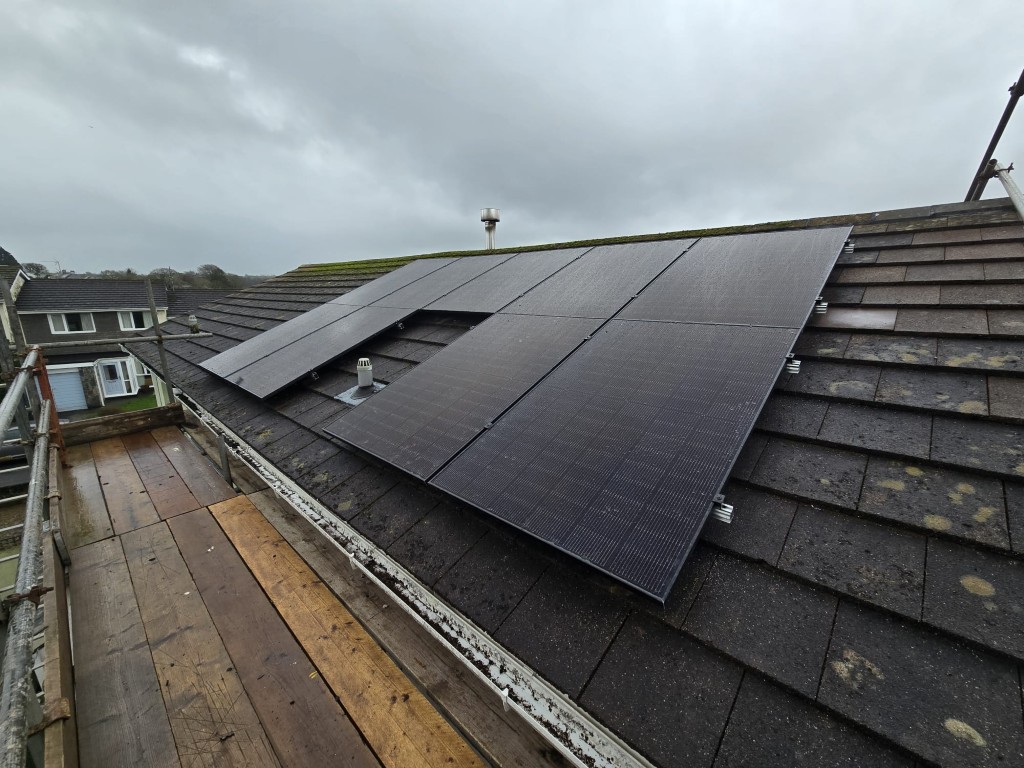
Roof close-up after installation
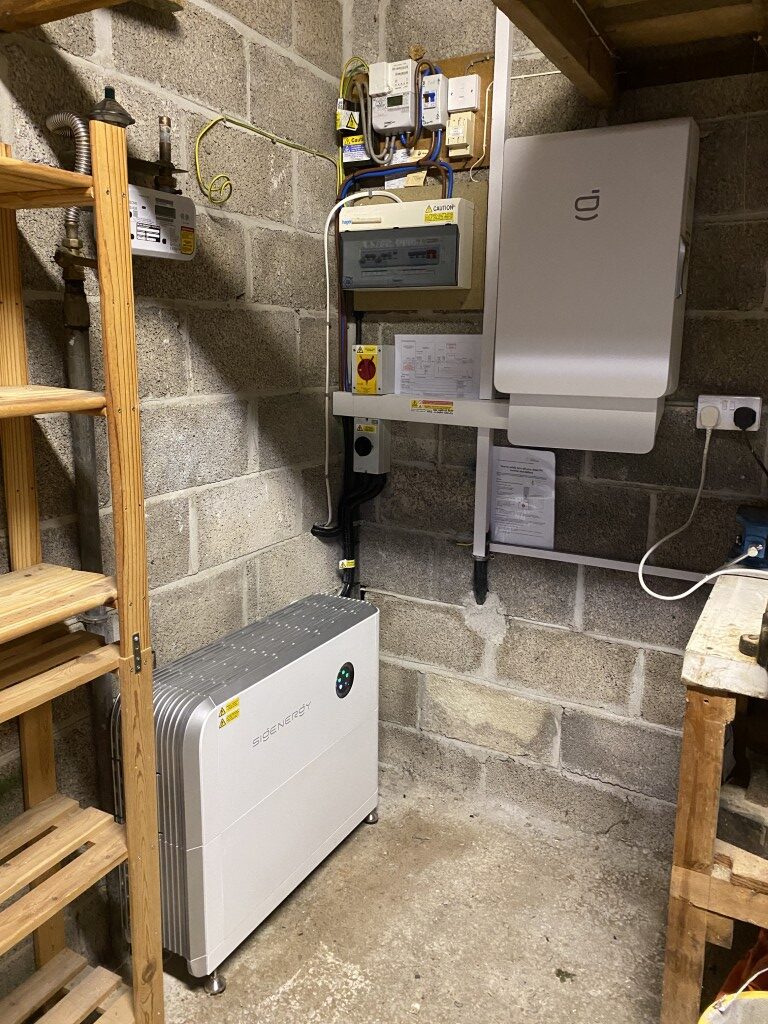
Battery, inverter & gateway installed in the garage
What’s installed
Our roof runs East/West rather than the usual South-facing pitch, so we split the array evenly across both sides rather than losing half the roof.
| Panels | 18 x JA Solar 450W N-type Bifacial Double Glass panels — 8.1 kWp total (9 panels facing east, 9 facing west, both at 27° pitch) |
| Inverter | Sigenergy SigenStor EC 5.0SP — 5 kW single-phase controller |
| Battery | Sigenergy SigenStor BAT 10.0 — 9 kWh usable storage |
| Backup gateway | Sigenergy Gateway HomePro SP-F (100A) |
| Installed | January 2026, by Bloom Renewables (South Devon) |
| Warranties | 25-year panel product warranty, 30-year panel performance warranty, 10-year inverter & battery warranty |
| System cost | £14,726 including scaffolding |
| Payback | 9 years |
The gateway — why it matters
The Sigenergy Gateway is what turns this from “solar that switches off in a power cut” into a genuine backup supply: it can island the whole house from the grid and keep it running from the battery during an outage, rather than just backing up a couple of circuits. It’s the piece most solar quotes leave out, and the reason we specifically asked Bloom to include it.
How it’s performing
Bloom’s proposal estimated 7,458 kWh of generation a year, with 59% self-consumption without the battery, rising to an estimated 70% grid-independence with it. In practice, generation through spring and early summer 2026 has been running ahead of that estimate — in June and July we exported over 1,100 kWh a month to the grid, more than six times what we imported in the same months.
Bloom’s own financial projection: £1,380 estimated first-year saving, an 11.5% rate of return, payback in 9 years, and lifetime savings of £47,339 over 20 years against a £14,726 system cost — for an estimated net saving of £32,613.
Will it still be in credit through winter?
That’s the question that actually matters — solar makes money in the summer when there is lots of sunshine and daylight. We built a realistic month-by-month projection for the year ahead, modelled from our own actual import/export data.
| Month | Import | Export | Net for month | Running account balance |
|---|---|---|---|---|
| Sep 2026 | 296 kWh | 841 kWh | £53 credit | £618 |
| Oct 2026 | 374 kWh | 636 kWh | £17 credit | £635 |
| Nov 2026 | 417 kWh | 389 kWh | £19 cost | £615 |
| Dec 2026 | 456 kWh | 242 kWh | £43 cost | £572 |
| Jan 2027 | 446 kWh | 191 kWh | £48 cost | £524 |
| Feb 2027 | 362 kWh | 244 kWh | £28 cost | £496 |
| Mar 2027 | 341 kWh | 435 kWh | £2 credit | £494 |
| Apr 2027 | 261 kWh | 652 kWh | £35 credit | £529 |
| May 2027 | 214 kWh | 902 kWh | £70 credit | £599 |
| Jun 2027 | 180 kWh | 1,036 kWh | £91 credit | £690 |
| Jul 2027 | 195 kWh | 1,124 kWh | £99 credit | £789 |
| Aug 2027 | 239 kWh | 1,052 kWh | £86 credit | £875 |
| 12-month total | 3,780 kWh | 7,744 kWh | £310 net credit | — |
The account does cost money in the four darkest months (Nov–Feb, as you’d expect — that’s when the heat pump works hardest and the panels do least), but the credit built up over spring, summer and autumn is large enough that the balance never comes close to running out. Even at its lowest point, in March, we’re still projected to be comfortably in credit — and by the following August, back above where we started.
This is a projection, not a guarantee: it’s modelled from a seasonal curve fitted to our first 7 months of actual billing data (mid-January to mid-August 2026), because we don’t yet have a full winter of real readings with the new system running. Import and export rates are also not price-guaranteed beyond May 2027. We’ll update this table with real figures as the winter data comes in.
It’s already had a real effect on our bill: we’re on Outgoing Octopus for export — a variable rate that tracks wholesale prices, currently 12p/kWh with no standing charge — and between that export income and the battery covering most of our own usage, we’ve been able to cut our Octopus direct debit to the statutory minimum of £1 a month.
If you’re thinking of switching to Octopus Energy yourself, this referral link gets you £50 credit — and gets us £50 too.
How we monitor it
Everything — live generation, battery state of charge, import/export, and historical data — is visible in real time through the mySigen app.
Thinking about solar yourself?
We had two other quotes before choosing Bloom Renewables, and they were the standout on both equipment quality (Sigenergy rather than the more commonly-fitted budget brands) and workmanship. Read our review of Bloom Renewables.
Bloom run a referral programme: mention that Alan Lewis referred you (or ask us to put you in touch) and you’ll get 10% off your panels — we get £500 if you go ahead.
-
- Website: bloomrenewables.co.uk
- Contact: Rowland O’Connor, Sales Executive — 07950 319280 — rowland@bloomrenewables.co.uk