
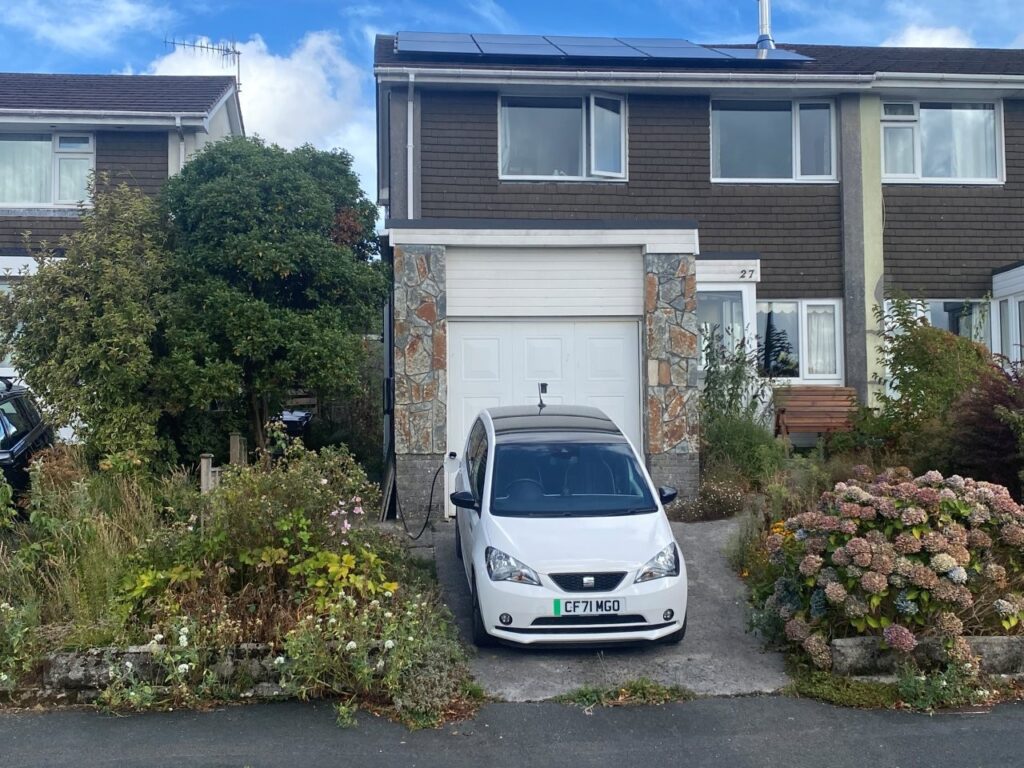
We have 18 solar panels on an East/West facing roof (8.1 kWp), supported by a 9 kWh home battery, and a 3.5 kW heat pump, all installed in January 2026, and also a 36 kWh electric car.
During the summer, the solar panels generate an average £100 surplus per month. The entire system is so efficient that we expect to achieve net-zero electricity bills year-round, even through the winter, and have been able to reduce our direct debit with Octopus to the minimum of £1 per month.
Our home is an ordinary small 3-bed semi. We doubled our loft insulation and added four new radiators to accommodate the heat pump, but no other modifications have been needed.
The short version
Our house is a completely unremarkable 1970s, timber-framed, brick-built, 3-bedroom semi in South Devon — 72 m² of floor area, nothing special about the fabric. We wanted to see what we could achieve with a non-disruptive eco retrofit to get off gas, reduce our carbon footprint and see how much we could save on our energy bills.
The results have surprised us
We expected to reduce our energy bills. We didn’t expect that the 18 solar panels would generate enough surplus energy to pay our energy bills and fuel an electric car year-round, but that’s how it’s working out.
What we did
Here’s what we did, in a five-week window at the end of January 2026:
- Solar & battery — 18 panels (8.1 kWp) plus a 9 kWh battery and a power-cut-proof gateway, installed by Bloom Renewables
- Heat pump — a 3.5 kW Vaillant air-source heat pump, installed by Heat Geek, replacing a 15-year-old gas boiler. Gas is now disconnected entirely
- Electric car — a Seat Mii (36 kWh battery), bought through Drive Green, charging via a 7 kW myenergi Zappi charger
- Insulation — loft insulation doubled from 270mm to 540mm. That’s it — no cavity wall insulation (not possible with this construction), no external wall insulation, no new windows (yet)
Explore each part of the project using the pages linked below, including the actual quotes we worked from, real performance data since installation, the tariffs we’re on, and the links and referral codes we’re happy to share if you’re considering doing the same.
Why we did it
Our old gas system boiler was 15 years old and due for replacement. Rather than like-for-like, we looked at what it would take to go fully electric. Heat Geek convinced us a heat pump could work in an ordinary house like ours without major building work, and the numbers on solar + battery stacked up well enough that we did both at once. The installers finished within a week of each other in January 2026.